And with that, the M3C4 team would like to wish everyone Marry Christmas and a happy New Year! Till next year!

Friday, December 23, 2011
In 2011, it seems that the one question that was on everybody's mind was: is self-healing of concrete possible? Even though it is not directly related to our project, we've been asking ourselves the same thing. Here is our suggestion:
And with that, the M3C4 team would like to wish everyone Marry Christmas and a happy New Year! Till next year!
And with that, the M3C4 team would like to wish everyone Marry Christmas and a happy New Year! Till next year!


Tuesday, November 29, 2011
Chloride ingress in cracked concrete
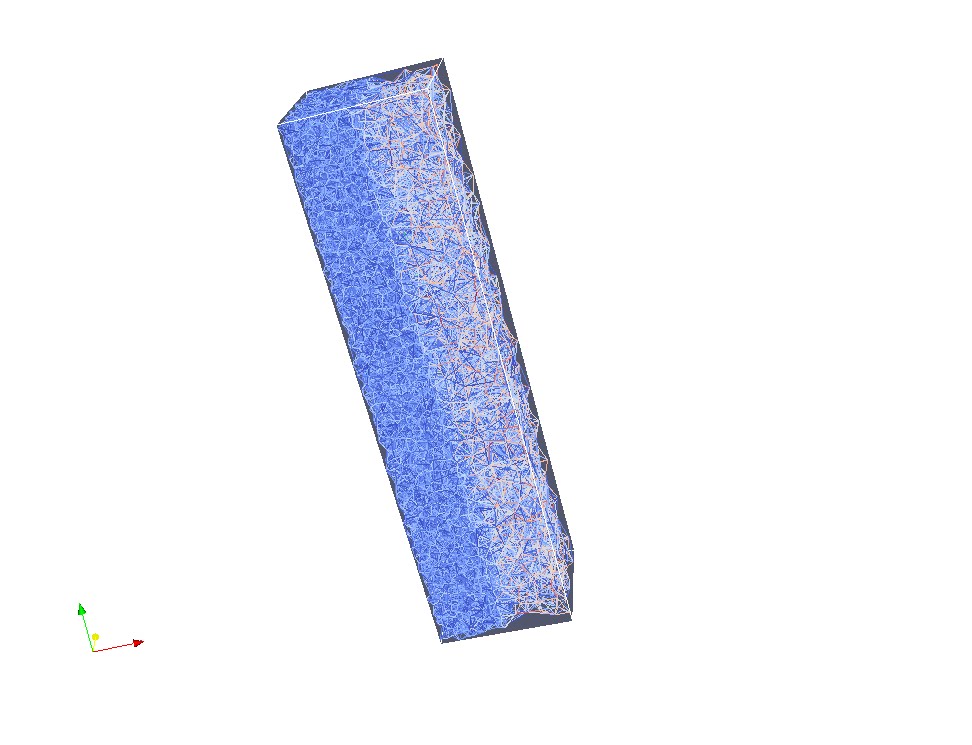
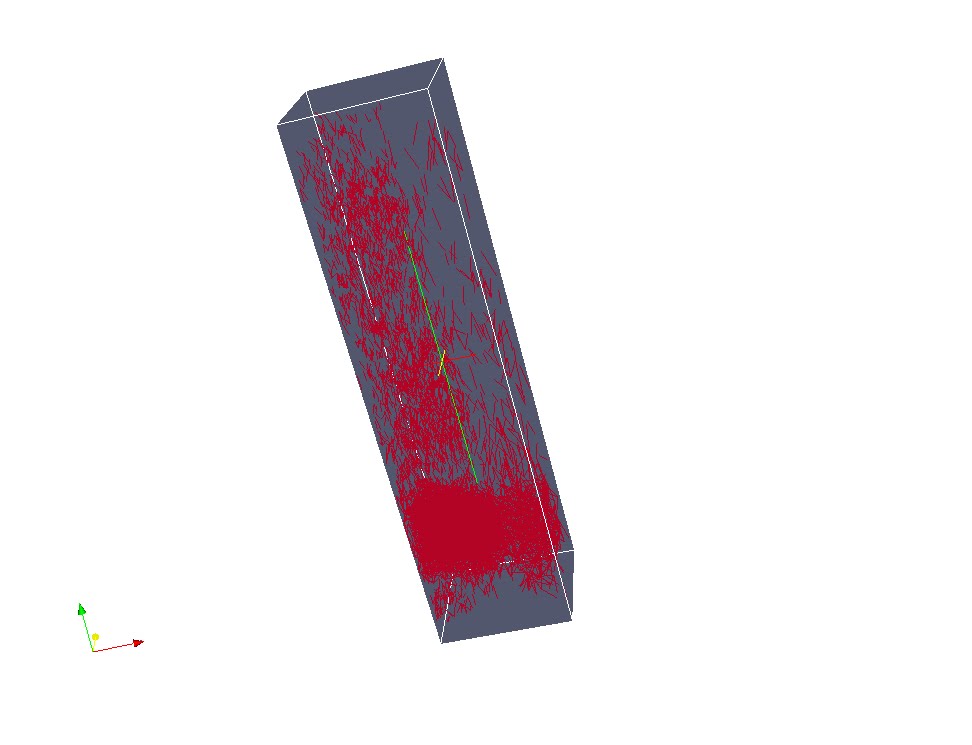
First simulation of chloride penetration in cracked concrete has been performed. A specimen (top) has been subjected to tension (below it-cracked elements after 15000 steps). Subsequently, it has been subjected to chlorides from the left side. Below are the chloride profiles at 30, 90, 180, 365, and 730 days, respectively. Till next time!


Thursday, November 17, 2011
RCM test
Rapid chloride migration testing is increasingly used in practice to assess the chloride resistance characteristics of a concrete mix. It is fast and simple, and can be performed with no fancy equipment whatsoever. Standardized as NT BUILD 492 in Scandinavia, it is also increasingly popular in the Netherlands. But, is there a faster way of testing? Well, of course there is: a numerical simulation! If we could simulate the test, different concrete mixes could be tried and the best one chosen. The first simulation of the test is here. Enjoy!
Here is the comparison of our simulations with some experimental data from the literature:

Here is the comparison of our simulations with some experimental data from the literature:

Thursday, November 10, 2011
Wedge splitting test
Wedge splitting test is a simple test often used in fracture mechanics. Some trial tests were perfomed in the Microlab last week. Here is the result:
Courtesy of our very own (official Microlab) photography maestro CA:

Courtesy of our very own (official Microlab) photography maestro CA:

Wednesday, November 9, 2011
Fracture simulation Brazilian splitting
Here is a video of (tensile) stresses which develop in a homogeneous specimen during the Brazilin splitting, predicted by the lattice model. Enjoy!
Tuesday, October 25, 2011
CTC


Friday, October 21, 2011
Meso-scale model
Concrete is a composite material containing several phases. These phases do not contribute equally to the chloride penetration, since some are more permeable than the others. Since this could be quite challenging to test in the lab, numerical simulation can give us some insight. In the video you can see, first, the concrete meso-structure (mortar, aggregate, ITZ), followed by the penetration of chlorides in time. Enjoy!
Thursday, October 13, 2011
Chloride, AZ
Chloride, AZ from Secret Ingredient Co. on Vimeo.
Chlorides are so relevant to our daily life, that a town in Arizona, US is named after them.
Enjoy!
Wednesday, October 12, 2011
Thursday, September 29, 2011
Concrete Solutions 2011

The M3C4 project contributed to the proceedings of the 4th International Conference on Concrete Repair - Concrete Solutions 2011. The conference was held on September 26 to 28th 2011 in the city of Dresden, Germany. New contacts, interesting feedback and a lot of fun are the result of such conference.
Until next time,
Subscribe to:
Posts (Atom)