Wednesday, February 13, 2013

The Cable Guy


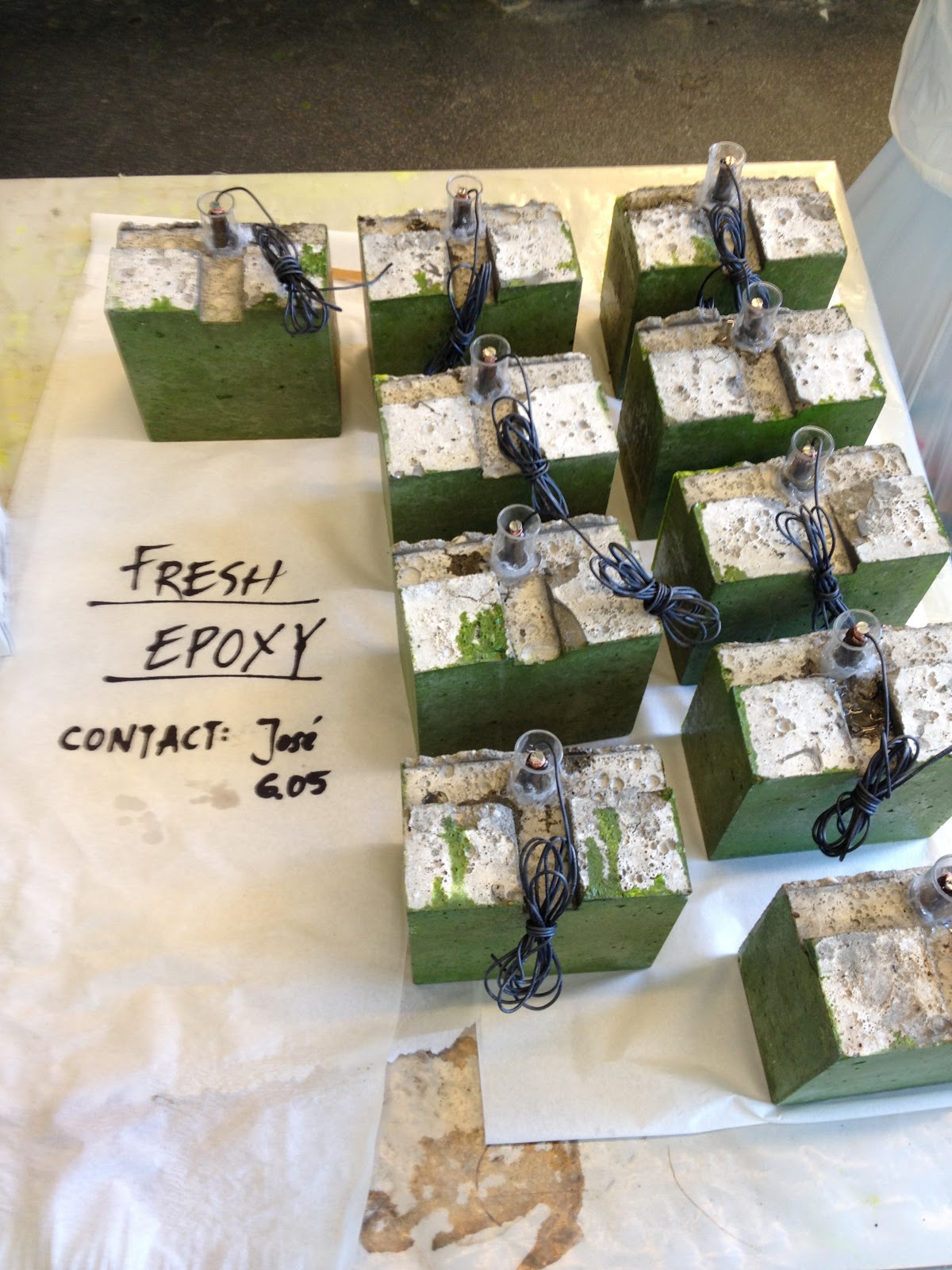
Today in the lab, a set of specimens was prepared by Jose... These specimens used for the CTC Round Robin test somehow reminded me of the movie "The Cable Guy"... Don't you agree?

Saturday, February 9, 2013

Of concrete and microscopes

The use of the scanning electron microscope (SEM) in concrete research is not new. One of the main advantages of using the SEM is the characterisation of elements in cement phases, hydration products (CSH) or deleterious reactions (ASR). Energy-Dispersive X-ray Spectrometry (EDS) is capable of detecting elements heavier than carbon (C), but in order to provide fully-quantitative analysis, a reference mineral must be employed.

Why is this reference mineral so important? Well, let me provide an analogy to explain it.


Imagine that your car's speedometer is not properly calibrated. It tells you that your speed is 60 mph, yet your driving speed is 100 mph. It would be hard to convince the police officer that you didn't intend to overspeed.

Going back to microscopes, the reference mineral will calibrate your EDS detector to acceptable values.  This will provide your research with strong scientific proof that the elements that you've encountered, and their atomic proportions, are correct. The selection of the reference mineral will depend on the elements you are interested in, their atomic ratios, etc. While it is not a simple task, it will improve your results dramatically.

Until next time,
Thursday, January 24, 2013

SEM training at WHD Microanalysis


The first half of this week I had the opportunity of visiting Aldeburgh (see above) and Woodbridge, UK; working place of Nick B Winter of WHD Microanalysis Consultants. For two days, Dr. Oguzhan Copuroglu and myself could talk to Nick, an expert on SEM microanalysis, and engage in great discussions regarding the possibilities of SEM for concrete and cementitious materials. Nick is an expert on this field with more than 30 years of experience; he even had the opportunity of working with Hal Taylor, known author of Cement Chemistry book. On top of that, Nick owns a SEM (see below) which is probably one of the best to have fun with. Turning knobs and clicking buttons does make a difference when learning this stuff. He was so kind to let me use it for a while and do some EDS analysis. Hopefully our collaboration will continue in the future.


Friday, January 11, 2013

New simulation results

Rapid chloride migration (RCM) tests are often used to characterize the resistance of concrete to chloride ion ingress. In the framework of the lattice model, this test can be simulated using a characteristic Galerkin approach. Although the mesh needed for the simulation is very fine (0.25 mm voxel size), this approach can be used to successfully simulate the RCM test in heterogeneous (meso-scale) concrete. To date, the only simulation of the ionic migration with the heterogeneous material structure (known to us) was published by Liu et al (2012) {Multi-phase modelling of ionic transport in concrete when subjected to an externally applied electric field, Engineering Structures 42, pp. 201-213}. We will therefore continue with this approach. Check out the video!


Tuesday, January 1, 2013

Goodbye 2012, Hello 2013!


The year has come to an end. It was full of great experiences, exciting results, new destinations and fruitful discussions. For the next year, the M3C4 team has many things to do. First, ESEM training in UK; conference in Toledo, Spain; microscopy conference in Chicago, US; and more. The first set of publications might come to light in this 2013, so fingers crossed.
The M3C4 wishes all lots of health, successful research and exciting adventures.
Until next time,

Thursday, December 13, 2012

V International PhD Student Workshop on Durability of Reinforced Concrete: From Composition to Service Life Design

The proceedings of the PhD workshop in Finland are published! The whole book can be downloaded at: http://www.vtt.fi/inf/pdf/technology/2012/T65.pdf
Rumor has it that the next workshop will be held in Aachen, Germany, in 2013. We'll just have to wait and see if that's true. Till next time!

Monday, November 19, 2012

Concrete cracking Pt1.

Cracks in concrete cover are definitely a concern for concrete infrastructure. The figure shows cracks propagate not only vertically, i.e. towards the reinforcement, but also horizontally once it has reached the steel bar position.  It is clear that the internal cracked concrete area is far larger the surface crack width. Hopefully, this will be taken into account in future durability design approach.


Until next time,

Jose

Friday, November 16, 2012

Betondag

Yesterday was the annual "Concrete day" (Betondag) in Rotterdam. The M3C4 presented their research. It was fun! See how Jose's enjoying it! Till next time!


Tuesday, November 13, 2012

Cracked concrete infrastructure

Betondag 2012 is coming next Thursday November 15th to Rotterdam. A brief, but interesting presentation regarding the influence of cracks on concrete durability will be given by two PhD candidates of the M3C4 project. If interested, don't hesitate to attend the presentations given by PhDs during Betondag.


Until Thursday!

Tuesday, November 6, 2012

Betondag 2012 + Birthday


M3C4 PhD candidates Branko Šavija and José Pacheco will be have a brief presentation of their work during Betondag 2012 in Rotterdam, The Netherlands. We will be glad to be there and want to meet, discuss or say hi to anybody who is interested in our project. For more information regarding Betondag 2012, please check the program:

http://www.betonvereniging.nl/?id=236


PS. The M3C4 group is happy to congratulate Branko on his 27th birthday. Many more of these to come!
See you