

Thursday, July 26, 2012
A day in the life...


Wednesday, June 20, 2012
Corrosion rates of steel in cracked concrete
Cracks in concrete cover allow fast penetration of aggressive substances such as chlorides, leading to reinforcement corrosion. In the Figure 1, corrosion rates of embedded reinforcing bars in concrete with transverse cracks with widths ranging from 135 to 375 microns are shown. It seems that crack width has an effect on the evolution of corrosion rate in laboratory conditions.
Figure 1.
In Figure 2 corrosion potentials are shown, providing indication of the thermodynamical condition of the steel reinforcement. One interesting effect is found on crack width of 217 microns. Although potentials are significantly less noble than the rest, corrosion rates were found to be the lowest of all specimens. It is clear that the experimentation must go on, but so far interesting results have been obtained!
Figure 2.
More results to be posted soon!
Sunday, June 3, 2012
SSCS 2012

On behalf of the M3C4 team, Branko took part in the first international conference "Sustainable Strategies for Concrete Structures", held in Aix-en-Provence, France. Dedicated mainly to numerical modelling and its impact on sustainable concrete structures and materials, the conference was a big success. Many significant researchers were there, and presented their work. As our team also presented a paper, usefull feedback from colleagues was obtained. On the other hand, this city has proven to be a very nice and pleasant place for such an event. Following the success of the conference, it is rumoured that the following one is going to take place in Rio de Janeiro, Brazil. The M3C4 team is looking forward to that!
.JPG)
Thursday, May 10, 2012
Microdurability Conference, Amsterdam 2012
Results obtained on the course of tM3C4's research were presented and published in the latest Microstructural-related Durability of Cementitious Composites in Amsterdam. Interesting discussion with colleagues and friends ended up in fruitful feedback for the project. More about M3C4's research is going to be published in SSCS 2012 in Aix-en-Provence, France and ICCRRR 2012 in Cape Town, South Africa.
Until soon!

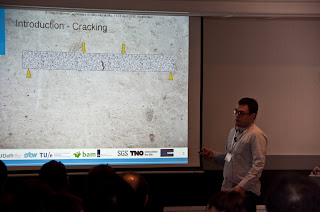
Results obtained on the course of tM3C4's research were presented and published in the latest Microstructural-related Durability of Cementitious Composites in Amsterdam. Interesting discussion with colleagues and friends ended up in fruitful feedback for the project. More about M3C4's research is going to be published in SSCS 2012 in Aix-en-Provence, France and ICCRRR 2012 in Cape Town, South Africa.
Until soon!


Monday, April 2, 2012
Corrosion induced crack patterns are influenced by many things. Rebar diameter, spacing, cover depth, and boundary conditions all play a role. In the videos, two different scenarios are compared: both specimens have 2 rebars of 10mm diameter, but one has a cover depth of 10 mm, while the other one has a cover depth of 20 mm. Crack growth in both specimens is shown. The difference is obvious.
However, in reality, corrosion rarely causes uniform expansion of the reinforcing steel. Therefore, it is possible that real pressure on the surrounding concrete acts in a different way (Ohtsu and Uddin, "Mechanisms of corrosion-induced cracks in concrete at meso- and macro-scales", Journal of Advanced Concrete Technology Vol.6 , No. 3, 419-429, October 2008):

The effect of different scenarios on the crack patterns in our model is visible in the following snapshots (at 5000 steps- yellow for visibility):


 (top to bottom- radial, horizontal and vertical loading scheme, respectively)
However, in reality, corrosion rarely causes uniform expansion of the reinforcing steel. Therefore, it is possible that real pressure on the surrounding concrete acts in a different way (Ohtsu and Uddin, "Mechanisms of corrosion-induced cracks in concrete at meso- and macro-scales", Journal of Advanced Concrete Technology Vol.6 , No. 3, 419-429, October 2008):

The effect of different scenarios on the crack patterns in our model is visible in the following snapshots (at 5000 steps- yellow for visibility):


 (top to bottom- radial, horizontal and vertical loading scheme, respectively)
It is clear that the loading condition makes a difference in the cracking behavior of the cover. Hope everyone is convinced! Enjoy the holidays!
Thursday, March 22, 2012
When the reinforcing steel bar inside concrete corrodes, it starts expanding, since the volume of the oxides that form during the process is higher than the volume of the original steel. It, therefore, exerts pressure on the surrounding concrete, which eventually cracks. To study the mechanism, the lattice model can be used. Here is the result of the first simulation of corrosion induced cracking. Enjoy!
Friday, March 16, 2012
The "rebar effect"
It has been reported in the literature that the buildup of chloride ions occurs at the top of the rebar. This means that the higher chloride concentration can be observed at the top of the reinforcing steel, than at the same depth to the side. Since reinforcement is impermeable to chloride ions, this actually makes perfect sense. Therefore, sampling the chloride ions at the side of the rebar to study, for example, the chloride threshold concentration, can lead to serious errors. This has be proven experimentally by Yu et al. (2007) in their study. So, what is a simple way to check this hypothesis? Well, numerical simulation, of course!
First figure shows the setup. Part of the mesh was was made impermeable to simulate the effect of reinforcing steel, while the chloride can freely penetrate the other side of the sample. The specimen was then subjected to chloride penetration for a certain period.

And here is the result:

Clearly, the phenomenon does occur. And what are the implications for the Round Robin test of the CTC Rilem committee? I guess we'll just have to wait and see!First figure shows the setup. Part of the mesh was was made impermeable to simulate the effect of reinforcing steel, while the chloride can freely penetrate the other side of the sample. The specimen was then subjected to chloride penetration for a certain period.

And here is the result:

Reference: H. Yu, W.H. Hartt, Y.P. Virmani, "Effects of reinforcement and coarse aggregates on chloride ingress into concrete and time-to-corrosion: Part 1-Spatial Chloride Distribution and Implications", NACE Corrosion 2007 Conference & Expo
Tuesday, February 28, 2012
Chloride exposure of cracked concrete

Concrete specimens with controlled crack widths just started to be exposed to a chloride containing solution. This experiment will show how fast chlorides penetrate into concrete on the vicinity of the crack.
More results to be posted soon.
Photo by: B. Šavija
Tuesday, February 14, 2012
Chloride binding
As chlorides penetrate into the concrete, some of them are physically and chemically bound to the cement matrix. Therefore, only free chloride ions can promote the further penetration. Also, only free chloride ions are responsible for steel depassivation and initiation of the reinforcement corrosion. This effect needs, therefore, to be included in our predictions. The simplest way to do this is to consider binding as a linear phenomenon. Some authors suggested, however, that this assumption is not suitable for a wide range of chloride concentrations. Therefore, non-linear binding isotherms (mainly Freundlich and Langmuir) are often used. First trials with the both nonlinear and linear binding have been performed, and here are the results!

Monday, February 6, 2012
ESEM

Some interesting results were obtained on the ESEM on the past days. There is still a group of samples to be analyzed this week and results seem promising! Part of this work will be published soon. Keep in touch for more upcoming updates.
Adios
Subscribe to:
Posts (Atom)